|

Hijab: An interpretation of Islamic women's dress
The debate about women's dress in Islam has become a controversial issue especially in the late
nineteenth and twentieth centuries, but for many centuries it was simply accepted that the almost
exclusively male interpretation of laws about women's dress carried the weight of divine sanction.
Today, Muslim women's dress has been politicised and carries with it many conflicting symbols and
meanings; perhaps the most visible is the use of headcovering as a resistance narrative against
western colonialism.
The following is one woman's interpretation of a Muslim dress code according to her
understanding of the Islamic requirements. There are relatively few ahadith - in comparison to
other topics - that deal with the issue of Islamic dress for women, and little attention has
been paid to assessing their contexts and harmonising them with the Qur'anic paradigm. As such,
only Qur'anic ayat have been addressed in the following interpretation because they are the sole
repositories of the Word of Allah (swt) that are accepted by Muslims without the reservations that
accompany the hadith canons. Further research into harmonising the ahadith about women's dress
should prove an exciting, albeit challenging, task which lies ahead for Muslim women; particularly in
light of the necessity of approaching the Qur'an and sunnah as a whole.
The first principle is that a Muslim woman has to have the right and freedom to choose how she
interprets her dress code. This fundamental acknowledgement of her innate ability to choose (or not)
the path of Allah (swt) is more important than any type of specifics about what constitutes
hijab (or appropriate covering of the body). Without this freedom to interpret Islam to the
best of her ability (a part of which, of course, is seeking the informed opinions of knowledgeable
Muslims in order to educate herself) she is not living up to her potential as a human being, and
that is more fundamental than what clothes are being worn.
As the Qur'an says:
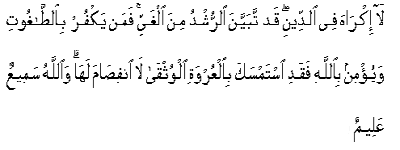
There is no compulsion in matter of faith. Distinct is the way of
guidance now from error... (al-Baqarah 2:256, A.Ali translation)
The most obvious reason why Muslim women have been given the freedom to interpret the Islamic
dress code is because it is not a subject of societal concern according to the Qur'an.
If it were, a sanction or punishment for failing to observe Islamic dress would be given -
just as there are punishments for adultery, murder, libel and so on. As it stands the Qur'an
leaves this matter up to the conscience of the individual.
Islam has been designed to be flexible enough to be interpreted in a variety of ways to cover
a variety of cultures, times, contexts, individual personalities etc. however it can safely be
said that there appears in the Qur'an, a concept that both men and women should dress (in public)
in a manner that will de-accentuate their sexuality1. The Surah an-Nur says:
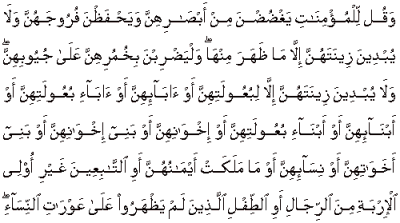
Tell the believing men to lower their eyes and guard their private parts...
Tell the believing women to lower their eyes, guard their private parts and not display their charms
except what is apparent outwardly... (an-Nur 24:30-31).
In order to achieve equity of results, (both men and women wearing de-sexualised dress)
women cover more, but this is merely a functional matter, it does not reflect on the value or
status or ability to move freely in public society.
This passage then goes on to suggest that believing women should draw their veils over
their bosom. The message of the verse is primarily concerned with covering the breast area
("juyubihinna"). If it were as fundamental for women to cover their hair, face, neck etc.
this would have been specified in the verse, as comparatively, the Qur'an is extremely
detailed in narrating which categories of people a woman can 'relax' and with whom she
can maintain private dress.
In the notes to this verse, Muhammad Asad writes in his The Message of the Qur'an:
My interpolation [in the translation of the verse] of the word "decently"
reflects the interpretation
of the phrase illa ma zahara minha by several of the earliest Islamic scholars, and
particularly by
Al-Qiffal (quoted by Razi), as "that which a human being may openly show in accordance
with prevailing custom
(al-'adah al-jariyah)". Although the traditional exponents of Islamic law have
for centuries been
inclined to restrict the definition of "what may (decently) be apparent" to a woman's face,
hands and feet - and sometimes even less than that - we may safely assume that the meaning of
illa ma zahara minha is much wider, and that the deliberate vagueness of this phrase is meant to allow for all the time-bound
changes that are necessary for man's moral and social growth. The pivotal clause in the above injunction
is the demand, addressed in identical terms to men as well as to women, to "lower their gaze and be
mindful of their chastity": and this determines the extent of what, at any given time, may
legitimately - i.e., in consonance with the Qur'anic principles of social morality - be considered
"decent" or "indecent" in a person's outward appearance.2
However there are also other ayat must be taken into consideration when deciding on
appropriate dress.
It must be said that the specific commands about seclusion (al-Ahzab 33:32-33)
apply only to the Prophet's wives as the Qur'an says they are not like any other women, and
the historical context of the verse demonstrates that the wives and in turn the Prophet were
vulnerable from the attacks of his enemies and the hypocrites which entailed the extra-ordinary
measures of protection applied to the wives of the Prophet: this does not apply to ordinary
Muslim women.
Having made that caveat, there is a reference to the generality of Muslim women in the ayat:

O Prophet! Tell thy wives and thy daughters, as well as all (other)
believing women, that they should draw over themselves some of their outer garments (when in
public): this will be more conducive to their being recognized (as decent women) and not annoyed.
But (withal,) God is indeed much-forgiving, a dispenser of grace! (al-Ahzab 33:59, Asad transl.)
The spirit of this ayat, is to dress in a manner that will signal 'unavailability'.
The context of this verse, it has been suggested, is that some of the hypocrites
were molesting women in the street and they argued that they had thought the women were
slaves and thus 'molestable'. Consequently, Muslim women were to dress to distinguish
themselves as modest and chaste and not 'molestable'. Now obviously it would be a
much better (and more Islamic) society to raise men not to molest women, than to
allow men to consider molesting unveiled women permissible. One could argue that this
command is context and time specific, and as such, dress is used as a marker of Muslim identity and
not necessarily an indicator of the moral status of the woman herself.
The final ayat that is germane to the discussion is:

As for your women past the age of bearing children, who have no hope of
marriage, there is no harm if they take off their outer garments, but in such a way that they
do not display their charms; yet if they avoid this it would be better for them. God is all-hearing,
all-knowing. (an-Nur 24:60)
The reason why this ayat is pivotal in gaining a broad overview of the Qur'anic
concept of appropriate dress is that it implies that women usually should wear in public
more than what they would wear in private, in front of their 'intimates' - their families.
So this leads to three basic 'points' in considering how to dress:
a) the universal idea of de-sexualised dress
b) the time and context specific concept of being identifiable as a Muslim
c) that before she reaches old age (and preferably after) a Muslim woman should wear more
in public than she would privately in front of family.
As long as these three injunctions are met, there is a wide range of options open to the
Muslim woman depending on the context of the society in which she lives and moves in public.
And Allah (swt) knows best.
1This point is made by Fadwa El Guindi in her book Veil: Modernity, Privacy, Resistance. (Oxford: Berg, 1999).
2Asad, Muhammad. The Message of the Qur'an. (Gibraltar: Dar al-Andalus Ltd., 1984), p538.
top
|